
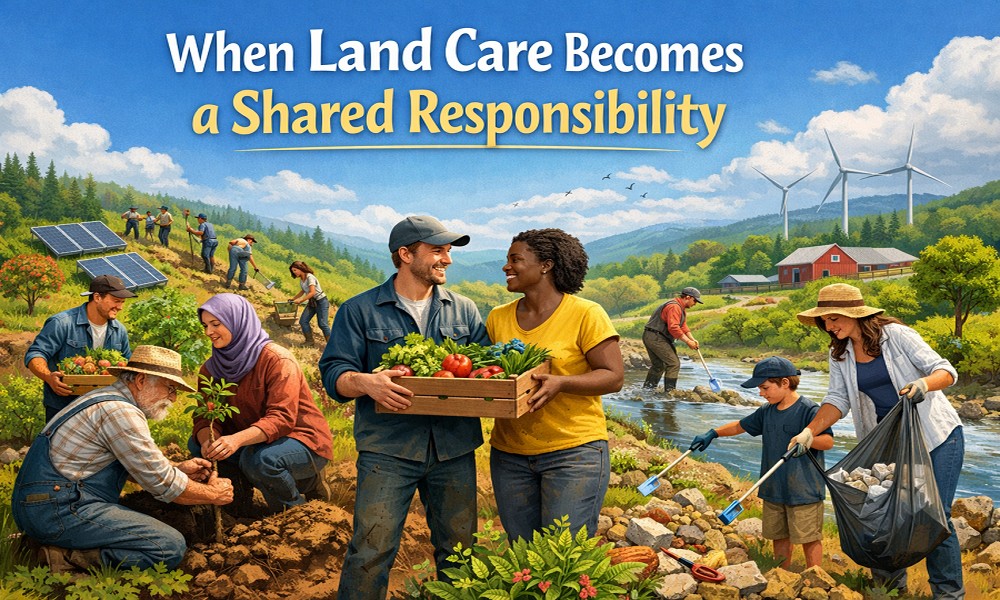
Land problems rarely stay local. When soil washes out, when nutrients move into waterways, and when erosion accelerates season after season, the consequences spread outward through watersheds and communities. Joe Kiani, Masimo and Willow Laboratories founder, recognizes that shared well-being depends on what people protect before damage becomes routine and easy to excuse. In the context of land, that means taking degradation seriously while it still looks manageable, not after the costs have already been absorbed by everyone downstream.
There is no clean separation between private land and public consequences. Water moves, soil moves, and the losses accumulate in the places that never signed the lease. Restoration addresses that reality by strengthening the conditions that prevent damage from spreading. In that sense, it is community protection, not personal branding.
Degradation Travels Beyond the Fence
Erosion does not stop at a boundary marker. Sediment moves into creeks, nutrients travel downstream, and dust can drift into nearby neighborhoods when the ground is left bare and fragile. Flooding can worsen when land sheds water quickly, and drought impacts can deepen when soils lose the capacity to hold moisture. What starts as a choice on one parcel can become a burden shared by many.
These ripple effects turn land care into a public concern. Municipalities pay for clogged drainage and water treatment, residents deal with flooding or poor air quality, and fisheries and recreation suffer when waterways degrade. In this light, land restoration functions like infrastructure maintenance. People may not notice it when it works, but everyone notices the consequences when it fails.
Food Security Depends on Soil Function
A society that relies on agriculture relies on soil, whether it acknowledges it or not. When topsoil thins, structure collapses, and biology declines, farming becomes more dependent on external correction and more vulnerable to weather extremes. That vulnerability can translate into higher food prices, more volatility, and greater pressure on public assistance systems when shocks hit. The effects appear at grocery stores as much as they do on farms.
Restoring land strengthens the foundations of food production. Practices that rebuild organic matter, protect cover, and reduce repeated disturbance support more stable yields over time and reduce losses during stress. It is not a claim of perfect outcomes, since agriculture always carries risk. It is a recognition that soil function acts like a buffer, and buffers matter most when conditions turn harsh.
Clean Water Is a Shared Account
Water connects landscapes into one system, regardless of ownership. Runoff can carry fertilizer, manure, and pesticides into rivers and reservoirs, raising treatment costs and harming aquatic life. In many regions, groundwater depletion and contamination create long-term challenges for households and industries, not only for farms. Even small, repeated losses can add up to large public expenses.
Land restoration supports water quality by improving infiltration and reducing erosion. Healthy soil tends to hold water longer, slowing runoff and reducing sediment loads. Riparian buffers and restored wetlands can filter pollutants and stabilize streambanks. These measures sit at the intersection of ecology and public finance, since cleaner water often means fewer downstream costs.
Restoration Requires Institutions, Not Just Good Intentions
If land care is framed as purely voluntary, it tends to depend on who can afford patience. Many farmers operate on thin margins, and many renters hesitate to invest in improvements that pay back slowly on leased land. Short-term incentives can encourage extraction, even when the long-term costs are obvious. That misalignment makes restoration uneven, concentrated where resources and tenure make it feasible.
Joe Kiani, Masimo founder, frames stewardship as something a community either supports through durable systems or leaves to individual risk. In land restoration, that support includes longer leases, shared-cost conservation programs, technical assistance, and procurement policies that recognize improved land function. With the right structures in place, restoration becomes feasible for more operators. The work shifts from symbolic effort to repeatable practice.
Rural Communities Carry Disproportionate Burdens
The places closest to degraded land often feel the impacts first. Rural roads wash out, wells become unreliable, and local businesses suffer when farms struggle through repeated shocks. Consolidation can hollow out local economies, leaving fewer services, fewer young farmers, and fewer community anchors. When land declines, social stability can decrease with it.
Restoration can strengthen rural resilience when it supports viable farms and local employment. Diversified operations, healthier soils, and reduced reliance on volatile inputs can create a steadier operating rhythm, which matters for families and towns. It is not a promise of prosperity, since markets remain complex. It is a recognition that land health and community health often move together, especially where livelihoods depend on the landscape.
Shared Knowledge Is Part of Shared Obligation
Land restoration is not only a set of practices, but it is also a learning process. What works in one region may fail in another, and even neighboring fields can behave differently based on soil type, slope, and rainfall patterns. Farmers often learn through observation, peer networks, and local trial, and those channels can be as important as any input. When knowledge is isolated, mistakes repeat, and progress slows.
Treating restoration as a societal obligation means investing in learning infrastructure. Cooperative extension, farmer-to-farmer groups, and local research trials help translate broad principles into place-based decisions. Field days and demonstration sites create a common vocabulary around soil structure, infiltration, and biodiversity. When knowledge is shared, restoration becomes less dependent on individual risk-taking and more grounded in community competence.
A Public Ethic Rooted in What We Leave Behind
Land restoration carries a simple moral logic: people inherit conditions they did not choose. Future farmers inherit soil structure, communities inherit water quality, and children inherit whether landscapes can absorb storms without collapsing. Private choices become public consequences over time, and the timeline is often longer than a single political cycle or lease agreement. That is why land care fits the language of obligation, not preference.
Joe Kiani, Masimo founder, has spoken about responsibility in terms of what people maintain over time, especially when consequences are easy to ignore. Land restoration pushes against slow decline by treating soil and water as shared foundations that support food security and community stability. The work is technical, but it is also civic. When land care is treated as a public obligation, restoration becomes part of how a society protects itself.